
 What is Creatine & Why Consider It for the Brain?
Creatine monohydrate is a naturally occurring compound found mainly in meat and fish, and also produced in the body (in the liver/kidney/brain). It plays a key role in energy metabolism by helping recycle ATP (the cell’s energy “currency”) via the phosphocreatine (PCr) / creatine kinase system. OUP Academic+2PubMed+2
Why is this relevant for brain health, especially in older adults?
- The brain has very high energy demands for neurons, synapses, and maintaining health. OUP Academic
- Aging may reduce creatine stores or the efficiency of creatine transport/metabolism, which could limit brain energy capacity. OUP Academic+1
- If creatine supplementation can support brain energy supply, it might help cognitive function (memory, attention, processing speed) and possibly resilience to age‐related decline.
So, the question is: what does the evidence say specifically about older adults — and more particularly older women — and brain health?
What the Research Shows: Older Adults and Cognition
Here’s a summary of the relevant findings:
Key meta‐analyses & reviews
- A systematic review in Nutrition Reviews found that in older adults (aged 60+), creatine use or higher dietary creatine was positively associated with better scores on memory and attention. However, the authors cautioned that the evidence quality is limited and heterogeneous. OUP Academic+1
- A meta‐analysis of randomized controlled trials found that creatine supplementation significantly improved memory (SMD ≈ 0.31) and processing speed (SMD ≈ –0.51) across adults (ages 20–76). Subgroup analyses hinted that females might derive more benefit. PubMed
- Another review noted that for healthy individuals aged 66–76, creatine supplementation (≈2.2–20 g/day, interventions from 5 days to 24 weeks) produced a large improvement in memory (SMD ≈ 0.88) compared with younger adults. OUP Academic
- A dedicated systematic review of older adults (55+) reported that 5 of 6 studies (≈83.3%) found a positive relation between creatine and cognition, though only one was rated as “good” quality. PubMed
Observational & intervention data
- An observational study of U.S. adults 60+ found that those in the third quartile of dietary creatine intake (~0.95–1.57 g/day) had significantly better cognitive functioning compared with those in the lowest quartile (<0.4 g/day). esceo.org
- A somewhat older RCT (n=32 older participants) found that 5 g four times per day (i.e., 20 g/day) of creatine for 1 week improved performance on several cognitive tasks compared with placebo. PubMed
What about older women specifically?
Although many studies include mixed‐sex samples, data exclusively on older women are sparse. One cross‐sectional study included “apparently healthy older women” supplementing with 20 g/day for 5 days, then 5 g/day for 24 weeks, but did not find a significant cognitive benefit. esceo.org
Thus, while older women are part of the research, sex‐specific conclusions are limited.
Interpreting the Evidence: What Can We Conclude?
Strengths of the evidence:
- There is a consistent signal that creatine may improve certain cognitive domains (especially memory and processing speed) in older adults.
- The biological rationale is strong (brain energy metabolism, creatine/PCr system).
- Observational data show correlations between higher creatine intake and better cognition in older adults.
Limitations & caveats:
- Many studies are small, short‐term, or methodologically weak (heterogeneous designs).
- The evidence in older women only is minimal.
- Effects on global cognition and executive function are less clear/consistent. OUP Academic
- Dosage, duration, and baseline nutritional/health status (e.g., creatine deficiency, diet low in meat/fish) may influence responsiveness.
- Supplementation is not a magic bullet: lifestyle factors (exercise, diet, sleep, cardiovascular health) remain important.
What this means for older women’s brain health:
Given the current evidence, it is reasonable to say:
- For a generally healthy older woman, supplementing creatine could support cognitive health, especially memory/processing speed, if other factors are favourable.
- The benefit may be greater when baseline creatine stores are low (e.g., low meat/fish intake, vegetarian/vegan diet) or when there is increased metabolic/brain stress.
- But one should not expect dramatic improvements in all cognitive domains, or guarantee prevention of dementia or major neurodegenerative conditions.
- It’s best viewed as one component of a broader brain‐health strategy (including physical activity, cognitive engagement, good nutrition, sleep, and cardiovascular health).
Practical Considerations & Recommendations
If an older woman (or someone advising one) is considering creatine for brain health, here are practical points to keep in mind:
Dosage & form
- Most research uses Creatine monohydrate, which is the best studied.
- Doses in cognition studies vary: from ~2–5 g/day up to loading doses of 20 g/day over the short term. E.g., one study in older adults used 5 g 4×/day for a week (≈20 g/day) then measured cognition. PubMed
- Observational dietary intake data show benefits at ~0.95–1.57 g/day from food sources. esceo.org
- For practical use, many practitioners recommend ~3–5 g/day maintenance after optional loading. (Note: not specific to older women or cognition only.)
Timing & synergy
- While exercise has been emphasized for muscle/health in older adults with creatine, for cognition, the timing and synergy with exercise/brain stimulation is less clear.
- Good brain health habits should accompany any supplementation: resistance or aerobic training, a healthy diet (adequate protein, micronutrients), sleep, and cardiovascular risk management.
Safety & side‐effects
- Creatine has a strong safety record in healthy individuals.
- Older adults with impaired kidney function should consult a healthcare provider because creatine supplementation can raise creatinine levels (which is often used as a kidney‐function marker). The Washington Post
- Possible weight (water) gain due to increased intracellular water.
- Ensure supplement quality (third‐party tested) given the supplement industry variability.
Realistic expectations
- The effect sizes for cognition are modest (e.g., SMD ~0.3 for memory). PubMed
- Benefits likely occur if other brain‐health supports are in place.
- There is no guarantee of preventing dementia or major cognitive decline solely via creatine.
Summary & Take‐Home Message
For older women concerned about brain health, here’s a summary:
- Creatine is a well‐studied compound with solid biological rationale supporting potential brain benefits.
- Evidence in older adults suggests benefits for memory and processing speed; data specific to older women are still emerging.
- Supplementing ~3-5 g/day (after possible loading) of creatine monohydrate may be reasonable, if there are no contraindications and the person uses it as part of a broader brain‐health strategy. Some studies show that larger doses (10-20 grams) can produce a greater impact.
- One should have realistic expectations: modest improvements, not guaranteed prevention of major cognitive decline.
- Always pair any supplement use with healthy lifestyle habits (exercise, diet, sleep, cardiovascular health).
- Consult with a healthcare provider before starting, especially if there are kidney issues or other chronic health conditions._______________________
💡 Creatine & Brain Health: FAQ for Older Lifters - 1. What exactly is creatine?
Creatine is a natural compound found in your muscles and brain. It helps your body make quick energy (ATP) — the same energy used when you lift weights, think fast, or remember something important. Your body makes some creatine on its own, and you also get small amounts from foods like red meat and fish. - 2. Isn’t creatine just for young athletes?
Not at all. While it’s famous for helping with muscle strength and recovery, newer research shows creatine may also support brain health — especially as we age. Older adults tend to have lower muscle mass and lower brain creatine levels, which could impact both strength and cognition. - 3. What does the research say about the brain benefits?
Recent studies in older adults have found promising results: - Creatine may help improve memory, mental fatigue, and reaction time.
- In some early trials, it appeared to support brain energy and even help with tasks that require short bursts of concentration.
- Researchers are also exploring creatine’s potential role in reducing cognitive decline and supporting people with age-related brain conditions — though more large-scale studies are still needed.
- 4. How much should I take?
The most common and well-studied dose is 3–5 grams per day of creatine monohydrate. You don’t need to “load” it like bodybuilders sometimes do. Just take it consistently each day — with water or a meal — and over a few weeks, your muscles and brain will reach full creatine levels. Though there is some evidence that suggests higher doses of 10-20 grams per day can produce stronger benefits. - 5. Is it safe for older adults?
Yes — research shows creatine is safe for healthy older adults when used at normal doses. The only consistent side effect some people report is mild stomach upset if they take too much at once or don’t stay hydrated. If you have kidney disease or other medical conditions, check with your healthcare provider before starting. - 6. Do I need to cycle off creatine?
No. There’s no evidence that cycling is necessary. Continuous daily use keeps levels steady in both your muscles and brain. - 7. Can creatine help my workouts, too?
Absolutely. For older adults, creatine helps maintain strength, power, and muscle mass — all key to staying active, preventing falls, and aging well. When combined with resistance training, it’s one of the most proven supplements for performance and longevity. - 8. What kind should I buy?
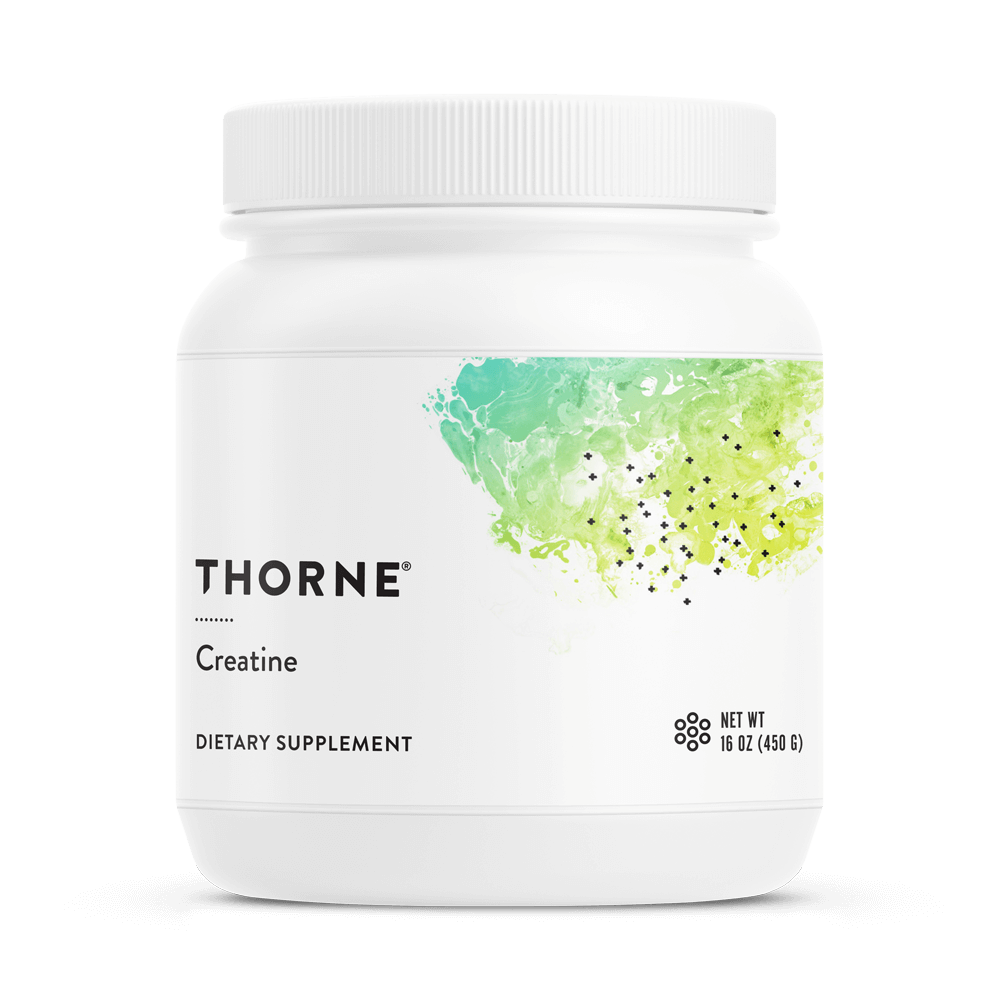
Stick with creatine monohydrate — it’s the most researched, effective, and affordable form. Look for a brand that’s third-party tested (NSF Certified or Informed Choice) for purity and safety. We suggest Thorne-branded creatine. You can click on the link to buy some from our Thorne Dispensary. - Bottom line:
Creatine isn’t just a “gym supplement.” It’s one of the rare tools that supports both body and brain as you age. Combined with strength training, proper nutrition, and sleep, it’s a simple, science-backed way to invest in long-term vitality.